Friday, 26 August 2016

The voice of the unheard


The voice of the unheard

Harold Wilson the former UK Prime Minister is credited with using the term; ‘a week is a long time in Politics.’ It’s also true that much can happen in the football world in 7 days. Last weekend we saw Celtic defeat St Johnstone in a display which was in parts exciting and encouraging for the future. On Tuesday the side faced up to Hapoel Beer Sheba in the heat of the Negev desert to book a place in the Group stages of the Champions League. Not since that torturous night in Oporto when Henrik Larsson booked Celtic’s place in Seville have I been so stressed watching a game of football. Celtic simply failed to find any fluency and found themselves 2-0 down with over 30 minutes left to play. It may be churlish to suggest that the Celtic of a year back would perhaps have lost that tie but Celtic this season are made of sterner stuff. The manager once again intervened and brought on Sviatchenko to stiffen his defence and in truth Hapoel seemed to run out of ideas in the final 20 minutes.

So it was that Celtic qualified for the lucrative Group stages of the Champions League. Our home performance, two silly goals apart, was accomplished and allowed us some leeway in the return leg. Of course the gossip in the media was all about the likely sanctions UEFA would impose for the displaying of scores of Palestinian flags in the stadium. The display was not limited to the Green Brigade section although it was more pronounced there. It seemed as if the supporters who wanted to make a point had done so in a peaceful if very public manner and cost the club another few quid. Then something remarkable happened. The Green Brigade decided to raise money for two Palestinian charities with an initial target of £15,000. They stated on the crowd funding page…

‘We, the Green Brigade, are the passionate Ultra fans of Celtic Football Club, Scotland’s most famous and successful football team. At the Champions League match with Hapoel Beer Sheva on 17 August 2016, the Green Brigade and fans throughout Celtic Park flew the flag for Palestine. This act of solidarity has earned our club respect and acclaim throughout the world. It has also attracted a disciplinary charge from UEFA, which deems the Palestinian flag to be an ‘illicit banner’ In response to this petty and politically partisan act by European football’s governing body, we are determined to make a positive contribution to the game and today launch a campaign to ‘match the fine for Palestine.’ We aim to raise £15,000 which will be split equally between Medical Aid Palestine (MAP) and the Lajee Centre, a Palestinian cultural centre in Aida Refugee Camp on the outskirts of Bethlehem. From our members’ experiences as volunteers in Palestine we know the huge importance of both organisations’ work and have developed close contacts with them. MAP is a UK-based charity which delivers health and medical care to Palestinians worst affected by conflict, occupation and displacement. Working in partnership with local health care providers and hospitals, MAP provides vital public health and emergency response services. This includes training and funding a team of Palestinian surgeons and medics to treat and operate on those affected by the recent conflict in the Gaza Strip.’

Celtic charitable roots are reflected in such laudable intentions and some also argue with no little justification that the Green Brigade also pulled of a supreme piece of political manoeuvring. Showing up UEFA and their contradictory and selective ideas on what actually constitutes ‘political’ displays at football. It did not go un-noticed that the draw for the Champions’ League group stages kept certain teams apart for political reasons. Celtic themselves have said virtually nothing on the display of Palestinian flags beyond a statement telling us they have been notified by UEFA that disciplinary proceeding are going ahead.

Few however could have predicted the world wide response to the Green Brigade’s ‘match the fine for Palestine’ appeal. The initial target of £15,000 has been superseded tenfold and at the time of writing £152,298 has been pledged. This astonishing amount of money has been raised from around the world with the Celtic support leading the way. The comments on the page reflect an admiration for the Celtic support doing something positive for those in need and highlighting the double standards adopted by UEFA. Of course some elements of the mediocre media we have here in Scotland tried to find an angle which attempts to take the shine off of what is an incredible example of ordinary fans taking positive and direct action.   The Scottish Sun, never noted for quality journalism, printed an obnoxious and frankly pathetic headline which stated: ‘'Celtic fans should make sure they're not raising money for terrorists.' Despite the Green Brigade’s Just Giving page being very clear on where the money raised was going this comic still found a way to throw mud but they are in the minority and football supporters (and many who don’t follow the game) from around the globe have congratulated the Celtic supporters for their humanity.

The fundraising has been highlighted in newspapers and news reports around the world and to my mind demonstrates the power of the internet when it is used positively. The ability to spread information and images around the world at the flick of a button or the click of a mouse has revolutionised communication. It also made it possible for people from scores of countries to become aware of the appeal and donate. The days of rags like the Sun virtually controlling the news agenda are long gone and we should all rejoice in that.

The words you will read in the comments section of the just giving page come from people from Australia to Aberdeen, from Lebanon to London, from Parkhead to Pakistan and from Liverpool to Lisbon. . The comments come from people with names like Anwar and Andy, Padraig and Pietro, Sean and Shafiq, Lynn and Latifah.  Here is a sample of what people are saying….

‘Thank you so much for your support. You are now my team.'

‘You have our support. One day apartheid in Palestine will end. From Benfica supporters.

‘The Scottish enlightenment continues! Well done’

‘Blue nose but happy to join fellow supporters to support the dispossessed. Well done everyone.’

‘Football can be the voice of the unheard; it’s the only moral left in the game. Be strong!’

‘I don’t even like soccer but colour me green because you’ve got a new fan.’

‘Thank you Celtic Fc and Green Brigade! You have a new fan for life.’

‘This is not about football. It’s about people like you and I. They say don’t hold a flag during an event the world is watching. I wonder why?’

‘This is solidarity, It’s integrity. It’s what you ask from your fans. Well done Celtic.’

I could go on and on with such comments but you’ll have gathered by now that the actions of the Green Brigade have touched a chord among many people. Modern football so often driven by greed and avarice has alienated many traditional working class supporters. But in this instance ordinary people have demonstrated that many followers of the game still use it as a vehicle for positive action. The raising of over £150,000 for charity by the Green Brigade is an astonishing and positive achievement. It is far more effective than any empty gesture politics at sending out a signal to people less fortunate that many do see their plight and do care. 

I was a little sceptical about displaying Palestine flags at the Hapoel game thinking it might harm the club I hold dear but some things are more important than sanctions of fines. This wonderful act of charitable giving has demonstrated yet again that Celtic fans can be a force for good in the game.

I’ve never been prouder of my fellow Celtic fans. Hail Hail to you all.


Friday, 19 August 2016

No regrets


No regrets

Wednesday night’s match against Hapoel Beer Sheva at Celtic Park was one of those pulsating games which make you glad you’re Celtic fan. After some fairly inept and flaccid performances in Europe during the Ronny years it was great to see the team flying out of the blocks, a support backing them to the hilt and a Manager with the cojones to change things when the side had a wobble early in the second half. The tie is far from over but there is a verve and pace about Celtic’s play which bodes well for the season ahead. It’s hard to think of a player who didn’t contribute to a solid and in the end convincing victory. Walking out of the stadium there was a buzz, a feeling that something good was finally happening at Celtic after years of down-sizing and cost cutting. One fan I spoke to said it was like the beginning of the O’Neil years.

Football is a cyclical game in the sense that every few years there needs to be change, a new beginning at a club. Celtic has laboured in Europe in recent years and in truth the fans know success in Scotland alone is never totally satisfying. Of course, we don’t expect to win the Champions League but we should expect to field a side which at least competes against clubs of similar stature. Too often we have lost to sides with a fraction of our resources and that needs to change. The arrival of Brendan Rodgers indicates a more ambitious approach from Celtic. A manager of his stature wouldn’t have taken the job without assurances that he would be able to mould the squad into a more effective unit. That costs money and the arrival of Scott Sinclair and Kolo Toure suggests Celtic will now spend reasonable money. Sinclair cost around £3.5m and while Kolo came on a free transfer, both players will be on wages suitable for players who have played in the English Premiership. Rodgers was undoubtedly one of the main reasons they came north and the contacts and reputation he has in the games will serve Celtic well. With others such Mousa Dembele and Dorus De Vries adding to a squad that already had some talented players then there is genuine optimism that Celtic are on the up. In the wake of the 5-2 victory over Hapoel, Rodgers stated when asked if he was planning to sign another quality player…

‘Always with the club it’ll be about affordability and availability but certainly the club has shown thus far that they are prepared to back what it is I want to do,  the types of players that we want to bring in and I’m sure this one will be no different.’

He is undoubtedly a man who knows where he wants to take Celtic and has embraced the club with the affection of a fan and the dedication of a manager who knows the score. Rodgers has so far shown he is exactly what Celtic needed to reignite the support and mould a team worthy of Celtic’s traditions.

As I looked around Celtic Park on Wednesday evening there was that old, familiar atmosphere. The stadium fairly rocked as the Celtic songs boomed out. There is no doubt that the noise had an effect on the Hapoel players as their manager admitted. He said post-match that he ‘had never heard such a noise in a football stadium.’ Rodgers himself said that the support were Celtic’s twelfth man. That wonderful backing of the team is one of the distinguishing features of Celtic in Europe. Success in Europe is so important to the supporters that they give their all and go home exhausted after big games. The Champions League is tantalisingly close but Rodgers is long enough in the tooth to know the job is only half finished.

The many Palestinian flags on display during the game have led to UEFA opening disciplinary proceedings against Celtic. It also opens up to clear view the chasm of hypocrisy which goes on at football with regards to ‘political’ displays. Games in UEFA sanctioned competitions must follow their rules and the key words in the rule book frown upon…

‘The use of gestures, words, objects or any other means to transmit any message that is not fit for a sports event, particularly messages that are of a political, ideological, religious, offensive or provocative in nature.’

Yet we see fines for Barcelona over the flying of Catalan flags by their supporters while simultaneously the Israeli flags at Ajax are routinely ignored.  We see clubs such as Celtic, Dundalk, St Johnstone and Omonoia (Cyprus) being fined for supporters displaying Palestinian flags as they are deemed political yet UEFA encouraged the showing of banners marking the passing of Nelson Mandela. The great man was considered a freedom fighter by some and a terrorist to others at points in his life before eventually becoming a politician and President of South Africa. It was as if the prevailing opinion that as he was fighting apartheid this allows this expression of sympathy at his passing to go ahead at football games. Some would doubtless argue, with some justification, that the Palestinian people are also fighting an unjust system which has oppressed and dispossessed them for decades.

No one is suggesting a free for all regarding flags at UEFA controlled games as this would probably get out of hand given the lunatic fringe which attaches itself to some clubs, most notably in Eastern Europe. However the ruling body should be seen to be above reproach and applying the rules without fear or favour.

UEFA allows its member Associations discretion to police what goes on in domestic games and here in Scotland we’ve seen our share of political controversy. The Green Brigade’s Bobby Sands and William Wallace display was designed to show that our societies wilfully promote some political or historic figures which discouraging or even banning others. The annual fuss over wearing a poppy is another political intrusion into sport as is the god awful tacky goings on at Ibrox on armed forces day. Firing guns and abseiling down stands is hardly a sombre act of remembrance. Nor is the singing of bigoted songs during these jamborees. You cannot have it both ways, either sport is kept out of the political arena or it isn’t.

Many feel strongly that the west and the media here have their own agenda and allowing the Palestinians a voice is seldom part of it. From around the globe though there were messages of thanks from Palestinian groups who had witnessed the events at Celtic Park. Whether you think the flag display was noble or (in the words of journalist, Tom English) ‘idiotic,’ it can’t be denied that many saw this non-violent act of defiance as a welcome gesture of solidarity with a suffering people.

UEFA may well fine the club again but for those who took part in the display, there are no regrets.


Saturday, 13 August 2016

Light in a dark place


Light in a dark place

When the draw for the European Cup was made in 1968 it paired Celtic with Hungarian side Ferencvaros. Celtic Chairman Bob Kelly was perturbed as Hungarian Troops had been among the Warsaw Pact forces which invaded Czechoslovakia that summer to crush the ‘Prague spring’ which had seen the Czechs demand a more liberal future less dominated by the USSR. 200,000 Warsaw Pact troops and 2000 tanks entered the country to crush the Czechs. 72 citizens were killed and hundreds wounded by the invading forces. Bob Kelly, a man of principle, sent a telegram to UEFA stating that the European Cup draw should be redone or Celtic would withdraw from the tournament. Kelly was adamant that sport could not simply ignore such brutal suppression. He would well remember the similar occupation of Hungary in 1956 when the sporting world said and did nothing in support of the Hungarians. UEFA for once agreed with him and the draw was remade keeping teams from the west and the Soviet Block apart.  Several Soviet Block countries withdrew from the tournament, it seemed they had at least heard the message Kelly was sending out. Kelly received a Knighthood a year later and some suggested his principled stand and honesty went part of the way to securing it.

It wasn’t the first time Kelly had stuck to his principles when he saw an injustice being done. The great ‘flag flutter’ of the early 1950s saw Kelly take on clique in the SFA who had no love for Celtic. After trouble at an Old Firm game they insisted Celtic remove the Irish flag which flew above the old Jungle. Glasgow Magistrates had asked the football authorities to ban flags which might have a provocative effect on supporters of both teams. The cabal at the SFA saw this as a chance to get rid of that symbol of Celtic’s Irish heritage, the tricolour. The SFA Council voted 26-7 that Celtic should remove the flag or face suspension. Kelly was having none of it. No doubt he was well aware of the forces that had ended Belfast Celtic’s involvement in football just a few years earlier.‘Tell me which rule we have breached?’ he asked them furiously. In the end they crumbled and Kelly was vindicated. The flag remained. Years later Desmond White commented on the leader of the clique at the SFA, Secretary George Graham, with the withering words...’ He’ll roast in hell for what he tried to do to Celtic.’

Bob Kelly’s insistence that sport cannot be blind to breaches of human rights or international politics was in keeping with his humanitarian principles. Almost 50 years have passed since he asked UEFA to redraw the European Cup or Celtic would withdraw. One wonders what he would make of the current discussion going on among sections of the Celtic support about the upcoming tie with Hapoel Beer Sheva. The Israeli city of Beer Sheva sits in the Negev Desert just 26 miles from the Gaza strip, scene of such horrendous slaughter during the IDF offensive of 2014. There is undoubtedly a well of sympathy among some Celtic supporters for the people of Palestine although some have only the shallowest understanding of the complexities of Arab-Israeli history. Few conflicts are as simple as saying one side is bad and the other good. That sympathy for the plight of the Palestinian people perhaps has its roots in the Irish dimension of the Celtic supports’ DNA which has a long tradition or remembering historical repression in Ireland. The debate occurring online seems to be about how those Celtic supporters who intend to mark the visit of Hapoel should do so. Some suggest the flying of Palestinian flags would show sympathy and support for that suffering people. Others say UEFA would hammer Celtic for this and that as the club has an increasing record of such incidents among the support, there may well be sterner action than another fine. Others suggest ‘lighting up’ the stadium with their mobile phones on the 67th minute; 1967 being the year of the war during which the Israeli’s occupied much of Palestine.

One wonders what Bob Kelly would make of it all? The modern board would undoubtedly like the support to show up and give the team the fabulous backing they’re famous for and leave the politics at home. The world has undoubtedly changed since Bob Kelly asked UEFA to reconsider the 1968 draw. The Cold War context Celtic operated in then was certainly a factor in UEFA’s decision and in more recent times the ruling body has been coming down hard on political displays at football. Of course there is an element of hypocrisy in UEFA and FIFA’s sanctimonious posturing on keeping sport and politics apart as recent corruption scandals have shown. Ruling bodies who pontificate on what is acceptable should be above reproach themselves.

The issue of Israeli teams playing in European tournaments has led to protests in the past. Even friendly games such as that between FC Lille of France and Maccabi Haiffa in the wake of the Gaza slaughter in 2014 led to pro-Palestinian protestors invading the field and assaulting Maccabi players. That was of course totally unacceptable and achieved little. Footballers are not responsible for the policies of their government nor the actions of their country’s military. It is of course impossible to totally separate sport and politics but more subtlety is required when making a point.


One scene from the conflict in Gaza which is seared in my mind is the image of four children playing football on the beach moments before an Israeli gun boat fired a shell at them and killed them for no apparent reason other than the fact they were Palestinians. They became yet more statistics in that bloody summer of 2014 but for those who knew them they were friends, schoolmates, sons, children who died playing the sport sometimes called ‘the beautiful game.’ Jon Snow of Channel 4 news asked the Israeli Spokesman in the wake of this atrocity a question he struggled to answer…

‘The operation you’re engaged in is ‘Protective edge’ and its stated purpose is to protect Israeli civilians. How does killing children on a beach contribute to that purpose?’

Wednesday’s match with Hopeol Beer Sheva is above all a sporting contest which holds the prospect of a return to the Champions League for Celtic if we prevail. Should anyone choose to make a political point I would ask that it stays within the bounds of decency and the law. I am attracted to the idea of lighting up the stadium using mobile phones as the symbolism of light is powerful. It shines into dark places but it is also a sign of hope that the darkness of war and oppression needn’t last forever.


The four boys lost playing the game we love on that beach in Gaza were called; Ismail Mohammad Bakir, Mohammad Ramiz Bakir, Ahed Atif Bakir and Zakaria Ahed Bakir. Remember them and all the lost children of Gaza with dignity and respect.


Sunday, 7 August 2016

Badge kissers, bead rattlers and WGS


Badge kissers, bead rattlers and WGS

Celtic Chairman, Brian Quinn attended a rather gloomy meal with Martin O’Neil and others in the aftermath Celtic’s narrow loss to FC Porto in the UEFA Cup Final of 2003. The Board had tried very hard to fund Martin O’Neil’s dreams of building a Celtic side which did justice to the magnificent support the club could boast and the excellent stadium the team played in.  There is no doubt that O’Neil’s side was perhaps the best Celtic team since the Stein era but in the limiting financial world of Scottish football it was expensive to bring players of quality to the SPL. Quinn noted Martin O’Neil’s incredulity when he told him that the 2002-03 Season would see Celtic lose around £7m. O’Neil was stunned, ‘You mean we’ve made it to the UEFA Cup final and we’re still losing money?’ he asked Quinn. The Grey haired Chairman told him that the wage bill was the root of these loses and while it was a collective responsibility that it had gotten so high, it was now their duty as custodians of the club to try and live within their means. During Martin O’Neil’s 5 seasons with Celtic the combined loses were around £50m and that was simply unsustainable. The fact the club were committed to rebalancing the books in this era would see the days of spending £6m on players as happened with Sutton and Lennon in the past. Martin O’Neil left in May of 2005 after losing the title in agonising manner at Fir Park. A Cup win the following week was little consolation to the Manager or the fans who knew that sloppiness had thrown the title away in those last few games. A fine 2-1 win at Ibrox was followed by a 3-1 home defeat by Hibs and the jitters set in. The last few moments of the SPL season saw Scott McDonald punish Celtic for not nailing down a title they really should have won. Change was in the air and the Celtic support wondered who would lead the team through the challenges ahead.

So it was that Gordon Strachan took the helm at Celtic Park in 2005 and in truth the support greeted him with mixed reactions. Some recalling his playing days at Aberdeen when he was a fierce competitor and occasional tormentor of Celtic, waited to be convinced that he was the right man for the job. Nor was Strachan the type to curry favour with the support by giving any soundbites to the media he didn’t think were 100% true. His straight talking style irked some but was in equal measure refreshing to others. He said once…

‘You hear Managers say they can relate to the fans. That’s bollocks! I don’t know what it’s like to work all week in the pissing rain or down a mine or in a factory that’s crap. When they spend money to watch a bad team, well I’m sorry I don’t know what that’s like. I wouldn’t start that nonsense- ‘I’ve always loved this team-’ because I didnae, I was a Hibs fan till I was 14 and that’s it.’

Such a forthright approach was always entertaining but many sensing that cost cutting was in the air wondered what Strachan would be able to do with a diminishing quality of player and far less money to remould the squad than O’Neil had at his disposal. His opening match away to Artmedia Bratislava was an utter disaster as the players performed dreadfully and Celtic lost 5-0. The following week in a bizarre game at Fir Park they drew 4-4. Few if any Managers in Celtic’s long history could boast they had shipped 9 goals in their first 2 games! Despite this Strachan moulded an efficient side which won the SPL and League Cup. He brought in players such as Boruc, Zurawski, Nakamura and even an ageing Roy Keane. Passing them on the way out the door were stalwarts of the O’Neil era like Sutton, Agathe, Valgaeren, McNamara and Lambert. It could be argued that as the wage bill came down the quality of the squad also fell. However as Rangers continued to spend way beyond their means and dabble in tax avoidance schemes, history shows that Celtic had made the right financial decisions in that era. The stock market crash of 2008 led to a financial crisis of the type unseen since the 1930s and clubs with big debts began to feel the heat.

Gordon Strachan won 3 titles, 2 League Cups and 1 Scottish Cup in his 4 seasons at Celtic. By any measure this would be considered a successful spell in charge. He also led Celtic to the last 16 of the Champions League on two occasions and his sides defeated teams of calibre such as Benfica, Manchester United, AC Milan and Villarreal. To do this at a time of cost cutting was no mean feat and if the football wasn’t as free flowing as it had been under O’Neil at times at least it was successful. Despite Strachan’s success some supporters were vocal in their disapproval of the style of play he was adopting. It wasn’t the ‘Celtic way’ of playing some suggested and some in the media suggested Celtic fans were ‘spoiled’ and ungrateful. In one scurrilous article in the Herald Celtic fans were taken to task for their lack of appreciation of Strachan and the job he was doing at Celtic Park. However the reporter in question went too far when he suggested…

‘He was handicapped from the outset by not being Martin O’Neil, his predecessor but when he started to respond to criticism with a snarl and an evasive shrug they just made up their minds that he’s not Celtic class, whatever that means. Some fans would probably rather have a bead rattling Hoopy the Huddle hound than Strachan.’

Such reporting is at best attention seeking and at worst stereotyping nonsense. Strachan’s unpopularity with a minority was rooted in the perceived quality of play and his often sarcastic and cutting style in interviews. It is fair to say that Celtic, in common with all big clubs,  have among their support an element who never seem to be satisfied but to suggest any criticism of Strachan was linked to his background is nonsense. Fans can argue about the quality of play but what is a matter of record is the fact that Gordon Strachan led Celtic to considerable success at home and in Europe at a time of cost cutting and down-sizing.  That was no mean achievement. Yes, there were defeats which hurt or occasionally embarrassed the supporters during his tenure (Artmedia and Clyde come to mind) but there were memorable nights in Europe too and many of us would dearly like to taste those occasions again.

Strachan’s title successes showed that he could instil a pattern to the team’s play and add some fighting spirit. Many had given up on the title in 2008 when he pushed the side to an unexpected and memorable triumph in the wake of Tommy Burns’ death. The playing resources he had to work with were undoubtedly less strong than in previous years and he was pragmatic about the way he set his teams out to play. There was no Larsson to lead the line, no Moravcik to open the opposition defences and no Mjallby marshalling the defence, Strachan dealt with the daily realities of trying to build a team with less gifted players and maintain some modicum of success in in Scotland and in Europe. The records show that he succeeded.

Often we see things more clearly in retrospect and this is true in the passionate and heated world of football. Strachan was a successful Celtic Manager by any measure and brought honours to the club at home and gave the support some good nights in Europe too. All of this was done at a time of financial difficulty for the club. I found his honesty refreshing at times and one quote sums this up perfectly…

‘I couldn’t be turning around kissing badges- that just wasn’t me. I see players kissing badges, saying ‘I love you’ and then I see them sneaking out the door instead of signing autographs for people who have been standing outside for an hour.’’

What you saw was what you got from wee Gordon and he’d seldom sugar coat his opinions. Today he talks up Celtic during his TV work and shows that the club made a lasting impact on his life. He said with typical honesty at the time of his leaving in 2009…

"I wasn't going to pretend I came here as a Celtic supporter. I don't believe in kissing badges to get your support. I didn't know the words of Athenry. But I now know what it's like to be a Celtic supporter, because I am one now."


Friday, 29 July 2016

The Bug


The bug

Andy Gallagher looked at his old man as he sat up in the hospital bed. He was looking frail and grey as his illness reached it’s inevitable conclusion. ‘Mind I took ye tae yer first gem, Andy? Aberdeen at Parkhead?’ Andy nodded, ‘Aye, Da. We won 2-1 back in 85?’ Old Johnny pushed himself up in the bed, wincing at the effort, ‘Aye, you were six and tae be honest ye were more interested in the macaroon bar than the game in those days.’ Andy smiled, ‘Naw I wasn’t, I remember McClair scored the winner in the last minute and there was a minute’s silence for big Jock. That was the week he died.’ Andy’s smile faded a little as he thought of big Jock passing. He looked at his Dad, ‘What makes you ask about that game?’  His old man went on, ‘It was the St Mirren game that May when we won the league, mind when Hearts collapsed at Dundee? That was when I knew ye had the bug. I was pleased as punch the Celts won the league that day but looking at you, yer eyes shining, almost greetin’ cause yer team had done it. I knew then Celtic was in ye for life.’ Andy smiled, ‘Aye, I got the bug that day alright Da. Ye looked pretty pleased yerself, running oan the pitch and setting a bad example tae yer son.’ His old man laughed but it was cut short by a hacking cough. He pointed to the water jug and Andy poured him a glass of water. He watched his father, once so vigorous and strong drain the glass. When he had finished he looked at Andy, ‘My old man said I got when I was eight. He took me tae see the Lions play. They mauled the Huns 5-1. It was crazy in the Celtic end, losing at half time then the second half blitz and everybody going mad, could have been 8 that day but I’m not greedy.’  Andy smiled, he tended to avoid the term ‘Huns’ these days but for guys of his Dad’s generation it meant Rangers and their followers and nothing else. The P.C Brigade had hijacked the word for their own ends.

His old man went on, ‘Thing is, I was glad my Da took me to see Celtic, had some great times, met some great folk and learned about life along the way. I think you were the same when I took you.’ Andy nodded in silence, letting his father get to the point. ‘I want wee Scott tae go along and see if he likes it. Five generations of Celtic fans in our family going back tae yer great Granda Paddy Gallagher fae Donegal. We cannae let the new generation drift away.’ Andy watched his old man reach into the locker and bring out a white envelope. ‘He handed it to Andy, saying, ‘I spoke tae big Hutchy aff the buss and he squared me up wi these tickets for old time sakes. I was a member for over 30 years.’ Andy opened the envelope and saw it contained two tickets bearing the Champions League logo along the top. On them he read the words: ‘Celtic v Barcelona, 7 November 2012.’ Andy looked at his father, ‘Jeez Da, these are like gold dust!’ His old man lay back on the pillow, ‘Just take the wee man, see what he makes of it.’ Andy nodded, ‘Right ye are Da, here’s hoping we don’t get a battering.’ His old man smiled, ‘I’ve seen some great teams struggle at Celtic Park. Ye never write the bhoys off wi that support behind them.’ Andy touched his old man’s hand. ‘Thanks Da, I’m sure he’ll love it.’  The old fella’s regular breathing told Andy he was already deep in sleep.

The weekend before the Barcelona game Andy travelled to Tannadice and watched as Celtic dominated and led 2-0 into the closing stages. Then in 88 minutes MacKay Stevens scored for United and right at the end the hapless Efe Ambrose deflected a cross into his own net to give the hosts an unlikely draw. The Celtic support left the stadium brooding on their team’s defensive frailties and speculated on what Messi, Xavi and Iniesta would do to them in midweek. The odds on Celtic taking anything from that game were long indeed but that would be a very different occasion. Celtic Park under the lights on those big European nights could weave a kind of magic. They still had hope if not much expectation that Celtic could surprise them all and give the brilliant Catalans a run for their money.

The streets around Celtic Park were at fever pitch as 60,000 supporters moved through the November darkness towards the stadium which stood like a huge, green spaceship. Andy held Scott’s hand as they walked up Janefield Street towards the huge North Stand. He glanced at his nine year old son, ‘You looking forward to the game?’ Scott, head wrapped in a green and white woollen tammy smiled up at him, ‘Aye, Da I can’t wait to see Messi and Villa. Maybe Xavi will be playing too!’  Andy smiled back at his son, ‘Don’t be writing off Celtic son, you never can tell what will happen in football.’ He had taken Scott to a few SPL games but as yet it was something of an effort to get him to come along and leave his X-Box behind. They reached the queue at the turnstile and there was little room under the huge stand as thousands of fans waited for entry to the game of the season. Songs and laughter filled the air although few boasted that Celtic could actually win. ‘Just give them a good fight and we’ll be happy,’ Andy heard the man next to him say to his friend. Realism was always required when you took on a team of Barcelona’s quality.

As Andy guided Scott down the steps to his seat near the front of the North Stand he could feel the electricity in the air. Celtic Park was buzzing, the atmosphere crackled and the dark November night was split with songs pouring from the stands. From the Green Brigade’s corner he could hear…

‘Oh, oh, Victor Wanyama, Wanyama, Wanyama, oh oh!

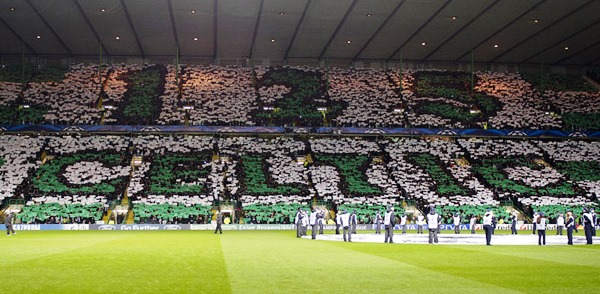
Scott sat on his seat and looked around him wide eyes taking it all in. On every seat was a rolled up piece of plastic and Scott picked his up, ‘What’s this for Da?’ Andy smiled, ‘We hold them up at the same time to make a big picture.’ Scott looked around him and noticed the plastic was on every seat, ‘Everybody’s doing it?’ he said incredulously. Andy nodded, ‘Oh Aye, the whole stadium.’ At that moment the public address system began ‘You’ll Never Walk Alone’ and the chatter in the stands stopped as tens of thousands of voices sang in unison and green and white scarves were raised around the stadium. It was an dramatic sight, an assault on the senses which young Scott watched in awe. Then, as the teams entered the field of play and the Champions League theme music echoed around the stadium, almost 60,000 coloured sheets of plastic were held in the air to create an astonishing mosaic which covered the stands of Celtic Park. Scott, standing on his seat, held his up with the rest. His father watched him, smiling.

As the game began Scott was totally focussed on the play. Much as he loved Messi and the other Barcelona superstars he was clearly backing Celtic. ‘Come on Celtic!’ he roared as Celtic mounted a rare attack on the Barca goal. From their seats near the halfway line they watched the ball arc across the Barcelona 18 yard box, a white blur under the lights. Scott watched open mouthed as Victor Wanyama out-muscled his marker and powered the ball past the goalkeeper and into the net. Celtic Park erupted like a pent up volcano! Andy grabbed his son in a wild hug, ‘Yasssss!’ Scott was equally enthusiastic, ‘We’ve done it Da, we’ve done it! We can beat them, I know it.’


In that moment Andy knew that Scott had caught the bug. The same bug he had caught when he watched Brian McClair scored a late winner against Aberdeen in 1985. The same bug his old man had caught when Stein’s team smashed Rangers 5-1 in 1966. Scott was hooked and his grandad would be a happy man.

They turned back to the field and watched Barcelona kick off a goal down. Whatever else happened on this incredible night at Celtic Park it was going to be an occasion  they’d never forget.


Sunday, 24 July 2016

Stand up for the Ulsterman


Stand up for the Ulsterman

A few years ago I was lucky enough to visit St Peter’s Basilica in Rome and I can honestly say that whether you are a religious person or not it is simply magnificent. I wandered around the cavernous church as shafts of bright sunlight poured in the windows of the massive dome giving the place a ethereal quality. Of course one is impressed by the sheer scale of St Peter’s and the elaborate beauty of the place but one artwork in particular made me stop and stare longer than any other. It was the white marble Pietà sculpted by Michelangelo in 1498-99. The Pietà shows the Virgin Mary cradling her dead son in her arms after he is removed from the cross. There are all sorts of theological messages in the Pietà and discussions of the greater meaning of such works could fill volumes. For me though, the simplistic and very human scene is what struck me most. Here was a woman who loved her son, worried about him and finally saw him put to death in a most painful and public manner. The Pietà captures her anguish so well. As I gazed at the Pietà, another image came to my mind. It was a picture from the Iraq war which showed yet another mother cradling her lost boy.  It made me realise that we humans have always had to deal with suffering but also that our stupidity and greed creates so much of it unnecessarily.


Yesterday at the Celtic v Leicester City friendly game the Green Brigade unfurled a tribute to a boy sadly lost in the most tragic of circumstances. I can’t begin to imagine the anguish his family are going through but perhaps in a tiny way the message sent out in the banner was a small reminder that we do care. In all the years I’ve followed Celtic there was always a realisation among the vast majority of supporters that some things are bigger than football and our petty rivalries. We have witnessed support across the board for Fernando Ricksen and his ongoing battle with the God awful Motor Neurone Disease. Similarly, respect was shown when fine players such as Jim Baxter, Tommy Burns, Sandy Jardine or Jimmy Johnstone passed. It was as if their abilities as footballers and qualities as human beings made everyone realise that the loss was bigger than any opinions about the clubs they represented. Likewise wee Oscar Knox won our hearts with his courage and spirit and I don’t mind admitting to shedding a tear as I watched him cavort with Celtic mascot Hoopy the Huddle Hound on a bright Summer’s evening a few years ago as Celtic hosted Cliftonville.


My old man went to the Pub in the aftermath of an Old Firm game at Ibrox one time. It was part of his routine in those days long ago, watch the game then talk about the action over a few beers. However that particular Old Firm game was scene of a tragedy which he only became aware of as the news reports came in on the fuzzy, black and white TV above the bar. He told me once that, fans were herded in and out of grounds like cattle in those days and that the dreadful accident on Stairway 13 could just as easily have happened at the other end of the ground. Rivalries, no matter how fierce, meant nothing when the scale of human suffering became known. All decent supporters know this and that common decency marks them out from that irksome minority, too thick or too full of hate to empathise with the sufferings of their fellow football fans and fellow human beings.

I’m proud of the way Celtic extended the hand of friendship to Liverpool FC in the wake of the Hillsborough tragedy. I know for a fact that among the 60,437 supporters who turned up that spring day in 1989 for the memorial match at Celtic Park, a sizable number were followers of clubs other than Celtic and Liverpool. I know personally three Rangers supporters who stood on the Parkhead terraces that day to support in their own small way a suffering city and a hurting people. I also know from talking to Liverpool supporters over the years that they will never forget those who stood with them in their darkest hours and those who supported and encouraged them on the long road to justice.

It didn’t escape my notice during the Republic of Ireland’s match with Sweden at the recent European Championships that there was spontaneous applause around the stadium in the twenty fourth minute as the Irish supporters paid tribute to Northern Ireland fan, Darren Rodgers, (who was 24) who sadly died after an accident in Nice.  Thousands of Irish voices sang ‘Stand up for the Ulsterman’ in a lovely gesture of solidarity with a fellow fan and fellow Irishman.  The tributes left at the makeshift shrine where Darren died saw the unusual sight of Irish and Ulster flags side by side. All of these examples show us that the majority of football supporters are decent human beings who keep their rivalries in context. There are always a few idiots who say or do stupid things but they represent no one but themselves. 

The Green Brigade has in the past caused heated debate among the Celtic support with some of their more overtly political displays. But credit where it is due, their social conscience and direct action in terms of promoting a culture of anti-discrimination in our society, battling the oppressive OBF Act or organising food collections at the stadium for our local Food Banks have been in keeping with the best ideals of the club they support so well. Like all decent people they don’t do it for praise or for publicity, they do it because it is the right thing to do. Similarly yesterday’s banner was a touching tribute to a wee lad so sadly lost. Football can indeed be a force for good in society as long as the decent majority prevail. I’m passionate about my club. I’d go as far to say my life would very much the poorer without Celtic but I know it’s possible to love your team without hating anyone else.

If you ever get a chance to visit St Peter’s in Rome, have a look at Michelangelo’s Pietà. Yes, it reminds us of our own mortality but also perhaps that we’re all human too and that we all have a duty to each other. When that image of the Iraqi mother and her son came into my mind it also reminded me that we also have a duty to try as best we can to stop the war mongers and to resist those who spread hate.  Now more than ever the world needs the good people to win.


Tuesday, 12 July 2016

Bonfire of the vanities


Bonfire of the vanities

I saw a rather grim face friend of mine approaching in Glasgow city centre back in the 1990s. We met by the old C&A corner and I asked him why he was looking so down. He fished his light summer jacket out of a carrier bag and pointed out the copious amounts of spit on the back of it. He had walked into the tail end or an Orange Parade and the followers of the bands had apparently decided that his jacket, being green, was fair game for their ire. It was sadly not uncommon to hear such tales or see my fellow Glaswegians zip up jackets to hide Celtic shirts or tuck crucifixes out of sight when they heard the drums booming. Is this the society we want?

There are several pubs I’ve been in over the years which can boast a ‘Celtic end’ and ‘Rangers end’ of the bar. One in Glasgow I used to frequent on occasion had just this set up and although it sounds a little odd to any outsider it was actually a fairly friendly place. Folk mixed and chatted away and only when Glasgow’s two big teams met was there any discernible tension. A few years back I was in this pub and found myself beside a seemingly nice chap and we discussed football and related matters. It was no problem to me that under his arm was a carrier bag containing his Rangers scarf which he intended to wear to the match that afternoon.  I’m open to talking to anyone as there are few people we meet in life we can’t learn something from.  We chatted about football and both had our differing views on the state of the game.  I held my peace as he explained why he, a working class man from a peripheral Glasgow housing estate, voted Conservative. He then moved on to his membership of the Orange Order and I was genuinely interested in his reasons for being part of the organisation which to be honest I hold in some distain. ‘The glorious revolution was the beginning of civil and religious freedom in this country.’ he informed me. 

As I listened to his extolling of the virtues of King William and the golden era of peace and harmony he brought, I got to thinking of the power of myth over factual history. Rather than ushering in a time of ‘civil and religious freedom,’ William’s victory over King James led in the end to the penal laws and institutional discrimination against the Catholic majority (and to a lesser degree, dissenting Protestants) in Ireland which to modern eyes seems appalling. Among a long list of restrictions designed to keep them in the lower echelons of society, Catholics could not vote, hold office, own a weapon, own a horse worth more than £5, attend school, practice their religion or serve in the army. Presbyterians suffered, albeit less severely, under such laws too and this led some to throw their lot in with the United Irishmen in the 1798 rebellion. The Penal laws were described by Edmund Burke as being…

 ‘’As well fitted for the oppression, impoverishment and degradation of a people, and the debasement in them of human nature itself, as ever proceeded from the perverted ingenuity of man.’’

It took over 200 years for the last of the penal laws to be rolled back and the last of the restrictions were finally legally abolished in the ‘Government of Ireland Act. (1920) The man I spoke to in the pub seemed oblivious to all of this as I chatted to him. Indeed his eyes glazed over and he seemed to filter out anything which might challenge his world view. I don’t know if it’s lazy thinking or simply a refusal to consider the values he had been brought up with might be wrong but either way he was disinterested in any facts I had to offer. He seemed genuine in his outlook although looking back the words of Martin Luther King seem apt…

‘’Nothing in all the world is more dangerous than sincere ignorance and conscientious stupidity.’’

Of course all communities and countries have their myths and folk narratives which seek to bind the group together. Often historical reality is left behind or ignored in the name of creating a narrative which suits the group. We have seen this in Ireland where the 200,000 Irishmen who fought and suffered grievously in World War One were airbrushed out of history at a time the focus of much attention was the nation’s struggle for independence from Britain. So too with the ‘brethren’ of the Orange Order who like to portray themselves as doing nothing more than exercising their right to celebrate their history and culture. Alas the celebration of this ‘culture’ is often seen as little more than empty triumphalism and the sort of exclusivism most of Europe left in the history books long ago.

A week or two ago residents of the town of Falkirk received a leaflet through the door about the upcoming Orange Parade. The leaflet started with the phrase ‘Everybody loves a parade’ and went on to describe the event which virtually brought the town of Falkirk to a standstill as a celebration of ‘religious tolerance.’ For those of us who live with these ‘celebrations’ on an annual basis, tolerance is not the word which springs to mind. Glasgow currently hosts more Orange/Loyal Order marches than Belfast and the spectacle is not edifying.  This year’s event saw Orange bands playing the racist ‘Famine Song’ on Dumbarton Road as drunken hangers on sang along. We may not yet allow the burning of Irish flags and Catholic statues on bonfires as occurs each year in the north of Ireland but nonetheless seem to allow open exhibitions of racism at the parades. Indeed ‘Lodge Blairgowrie’ in Perthshire held its opening night a year back and had a flute band playing the Famine Song. It isn’t hard to find scores of such videos on YouTube and other examples of a culture which seems to define itself by what it stands against rather than what it stands for. The reformed branch of Christianity they claim to represent is hard to discern amid the drum banging and triumphalism. Surely the followers of Christ are meant to practice forgiveness, tolerance and love not denigrate their neighbours beliefs with displays of boorish bigotry? But then these events are less about Christian fellowship and more about that ‘We are the People’ mentality which so tediously rears its head in our land.

Scotland has changed greatly in my lifetime and much of that change has been positive. Some though cling to ideas of who they are which are increasingly out of step with the modern world. Most Scots have no time for such outdated and divisive displays of tribal identity and see them as unnecessary and even embarrassing. A new idea of what being Scottish is has grown and it has nothing to do with religion, skin tone or ethnic background. It has to do with accepting values such as inclusion, fairness, decency and respect for others and their beliefs.  Some may say this article doesn’t show respect for the beliefs of those attracted to Orangeism but I would say that when it divests itself of its more overtly sectarian aspects and becomes a positive force in our society it may earn respect.  

I don’t consider myself to be a bitter man and like to think I call out bigotry wherever I see it but it really is hard to make a case for our town centres grinding to a halt so a noisy minority can celebrate long gone battles with no relevance in modern Scotland. In a free society we are bound to support the right to peaceful assembly but we are no bound to support such divisive demonstrations with tax-payers money nor pay the huge Policing bill which accompanies them. Nor should the disruption to people’s lives and businesses be tolerated.

These marches have shrunk hugely over the course of my lifetime as their relevance in people’s lives has diminished. Orangeism no longer has any real political influence and is sustained as a mostly working class sub culture. Most of the men and woman marching each summer are in the fifty plus category and that decline will surely continue. Instead of burning people’s flags or religious statues some would do better to throw silly ideas of supremacy and triumphalism onto the bonfires and accept we can be different and still be friends and neighbours.

How I’d love to see a colourful, noisy Parade each summer which celebrates Scotland and all its cultural diversity rather than this rather depressing mono-culture.  A parade we could take our children to and celebrate being Scottish no matter our origins, beliefs or culture. One which doesn’t shout ‘We are the people’ but rather reinforces the fact that we are all the people and celebrate that fact.

Is that too much to ask?